

The property landscape across the North West is shifting. Evolving regulations and recent fiscal updates mean casual property ownership is losing some of its advantages and becoming more difficult. Approaching your portfolio with professionalism as a landlord is becoming more important.
For investors in Stoke-on-Trent and Crewe, structural choices determine long-term success.
The Shifting Fiscal and Regulatory Landscape
The Renters Rights’ Act continues to have an effect. Some investors are getting used to Making Tax Digital. We all await further details about the upcoming MEES. In the meantime, the recent Budget effects the performance of different ownership models. This article reflects on issues to consider and is provided for general informational purposes only. It acts as a reminder of why it is important to seek specialist tax and financial advice.
Concepts to Consider
Personal Ownership Pressures
Section 24 restrictions cap mortgage interest relief at a basic rate tax credit. New property income tax rates reach 44% for higher rate taxpayers. Additional rate taxpayers face rates up to 49%. Tax applies before deducting full finance costs. Consequently, lower yielding assets face compressed net margins.
Special Purpose Vehicles (SPVs)
Holding residential investments in a SPV/limited company can allow full mortgage interest deduction. Business expenses reduce taxable profit before Corporation Tax is applied at 19% to 25%. Retaining profits inside a corporate structure helps landlords compound capital for future growth.
Acquisition Surcharges
The 5% Stamp Duty Land Tax additional dwelling surcharge applies to all investment purchases. On an ST1 2-bed terrace priced at £104,000, this adds £5,200 up front. On a £221,000 ST4 3-bed property, it adds £11,050. Factoring these outlays into initial yield calculations is essential before making an offer.
Examining Local Yield Dynamics
Adopting professionalism as a landlord requires a data led approach to postcode selection. Our table shows how gross yield varies across Stoke-on-Trent and Crewe.
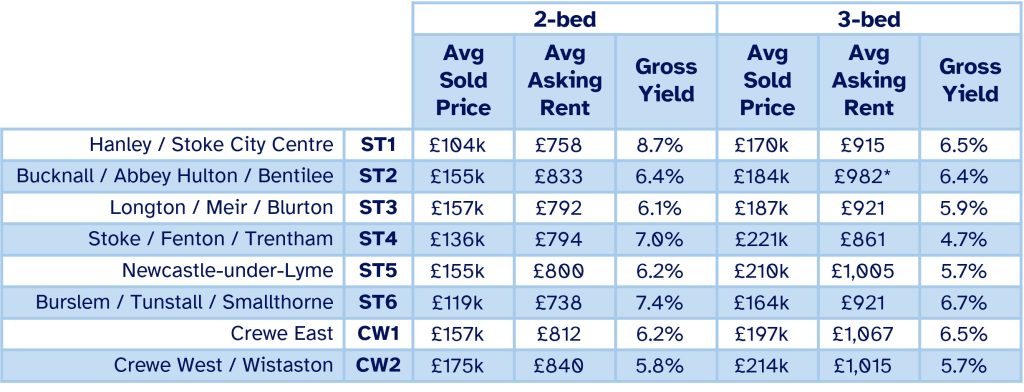
Source: Property Data, November 2026 *low sample size
High Yield Entry Markets (ST1 and ST6)
ST1 leads regional performance with an 8.7% average gross yield on 2-bed properties. Average sold prices in ST1 stand at £104,000. ST6 delivers 7.4% on 2-bed units at £119,000 and offers 6.7% on 3-bed properties at £164,000. These higher margins provide a strong buffer for financing and management fees.
Stable Defensive Markets (CW1)
CW1 offers a solid 6.5% average gross yield on 3-bed properties. Average prices reach £197,000 with monthly rents around £1,067. Supported by major employer hubs in Crewe, these properties appeal to landlords seeking tenant stability.
Low Yield Warnings (ST4 3-Beds)
Average sold prices in ST4 reach £221,000 against average monthly rents of £861, down from last month’s £970. This results in a, hopefully only temporary, low gross yield of 4.7%. In a higher interest rate environment, this lower yield profile requires strict cash flow testing.
What Professional Landlord Strategy Looks Like Now
Embedding professionalism as a landlord includes these three proactive operational steps:
Treating property investment as a structured business helps your portfolio remain resilient and profitable.
Looking to acquire Buy-to-Let property in Crewe or Stoke-on-Trent?